BoldVoice is an AI English accent-training app that pairs voice-coach video lessons with real-time pronunciation assessment and phoneme-level analysis, so learners can practise for ten minutes a day and make their speech clearer, more confident and easier to understand.
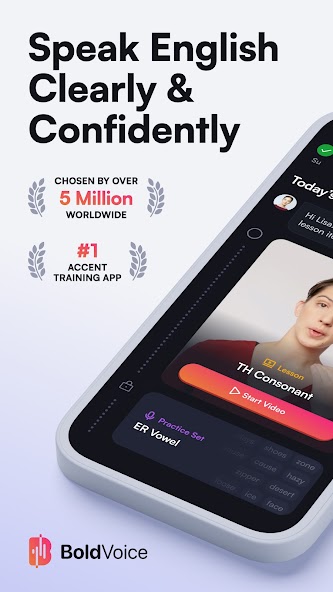
BoldVoice is an AI accent-training app for English, built around a simple promise: ten minutes a day, until your pronunciation sounds clear and feels confident. The curriculum was designed by a team of Hollywood voice and dialect coaches, while the AI handles the part a coach cannot scale — listening to you on every single repetition and telling you what was off. That combination produces a loop most learners never manage on their own: watch the model, imitate it, get a specific verdict, try again. For most non-native speakers the obstacle is not a shortage of material. It is the absence of anyone who will point at one vowel and say "that one, again". BoldVoice is aimed squarely at that gap.
What BoldVoice Is
BoldVoice separates pronunciation work into three layers that reinforce each other. The first is human expertise captured on video: professional coaches demonstrating mouth position, stress and rhythm, so you have a reference for what "correct" actually sounds like before you attempt it. The second is AI assessment that scores your attempt and suggests where to adjust. The third is visual feedback — voice comparison and phoneme-level breakdowns — which turns a vague feeling of "I have an accent" into a small, addressable list of differences. On top of those layers the app assembles a personalised learning path from your initial assessment and your native-language background, because a Mandarin speaker and a Portuguese speaker do not struggle with the same sounds.
Key Capabilities
Professional video tutorials. Lessons recorded by voice coaches explain pronunciation technique and demonstrate each target sound, solving the problem of not knowing what the correct version sounds like.
Real-time assessment and correction. The AI reacts to your pronunciation as you speak, flags the inaccurate parts and offers concrete suggestions, replacing guesswork with something you can act on.
Voice comparison tool. You can place your own recording beside a native speaker's and hear the gap directly, instead of carrying around a general sense that something is wrong.
Phoneme-level analysis. Words are broken down sound by sound, so feedback points at a specific phoneme rather than the whole sentence — which is what makes targeted repetition possible.
Personalised learning path. Your baseline assessment and native language shape the order of lessons and the amount of repetition, since the difficult contrasts differ from one language background to the next.
Business and professional vocabulary. Drills built around workplace English and professional phrasing, for people who need to sound credible in meetings rather than in a textbook.
AI conversation partner. Scenario-based dialogue that pushes isolated sounds into connected speech, where pronunciation actually has to survive.
How to Use It
- Take the initial assessment. Record the baseline first. The learning path and every later progress comparison are measured against it, so skipping this step weakens everything that follows.
- Commit to a fixed slot. Accept the generated plan and put your ten minutes at the same time each day. Short and frequent beats a long weekend session, because pronunciation is motor learning, not memorisation.
- Imitate, then compare. Watch the demonstration, repeat after it, then use the voice comparison tool line by line. Pay attention to the two or three sounds where the gap is widest rather than everything at once.
- Work through the feedback. Take the phonemes the AI marked and repeat them deliberately. Do not try to fix ten sounds in one session; clear them one at a time.
- Move into conversation. Once individual sounds hold steady, switch to the business or everyday dialogue modules and check whether the improvement survives in connected, spontaneous speech.
Where It Fits
- Business professionals who present in English to international teams and want to reduce the friction that pronunciation alone creates.
- Job candidates preparing for English-language interviews, who need to fix the issues that most affect intelligibility in a short window.
- Students preparing for presentations, seminars or thesis defences in English.
- Learners who already speak functional English but have plateaued at "understandable but not clear", and need feedback rather than more input.
Limitations and Things to Keep in Mind
Pronunciation training improves intelligibility and clarity; it does not replace work on grammar, vocabulary or the logic of what you are saying. AI assessment can lose accuracy in noisy conditions, so practise somewhere quiet with a stable microphone rather than in a café or on a moving train. Phoneme-level feedback depends on a recognition model, and it can misfire on very short words or on speech shaped by strong regional influence — when a judgement matters, trust the coach's demonstration. An accent is not a defect, and the goal here is to be understood, not to erase every trace of where you come from. Pricing, subscription terms and the current feature set should be checked on the official product page; nothing in this article should be read as a commitment on those points.
Frequently Asked Questions
Is BoldVoice suitable for complete beginners? It fits learners who already have some English and want to make it clearer. Someone starting from zero usually needs phonemic awareness and basic vocabulary first; imitation alone is inefficient without that foundation.
Is ten minutes a day really enough? Ten minutes is the rhythm the product is designed around. Whether it produces results depends on consistency and on whether you actually repeat the material the feedback flagged. The cost of restarting after a lapse is usually higher than the practice itself.
Will it make my accent sound native? That is neither realistic nor necessary. The target is speech that is clear, confident and easy to follow. Retaining some features of your first language does not undermine professional credibility.
Frequently asked questions
Is BoldVoice suitable for complete beginners?
It fits learners who already have some English and want to make it clearer. Someone starting from zero usually needs phonemic awareness and basic vocabulary first, and imitation alone is inefficient without that foundation.
Is ten minutes a day really enough?
Ten minutes is the rhythm the product is designed around. Results depend on consistency and on whether you repeat the material the feedback flagged. The cost of restarting after a lapse is usually higher than the practice itself.
Will it make my accent sound native?
That is neither realistic nor necessary. The target is speech that is clear, confident and easy to follow, and keeping some features of your first language does not undermine professional credibility.