Huimeng Workshop AI (https://huimengi.com/) is a one-stop AIGC creation platform made up of three product lines: the comic drama workflow, the DreamoTV free canvas and the API aggregation platform, covering script analysis, storyboard generation, character asset management, final video export and API integration.
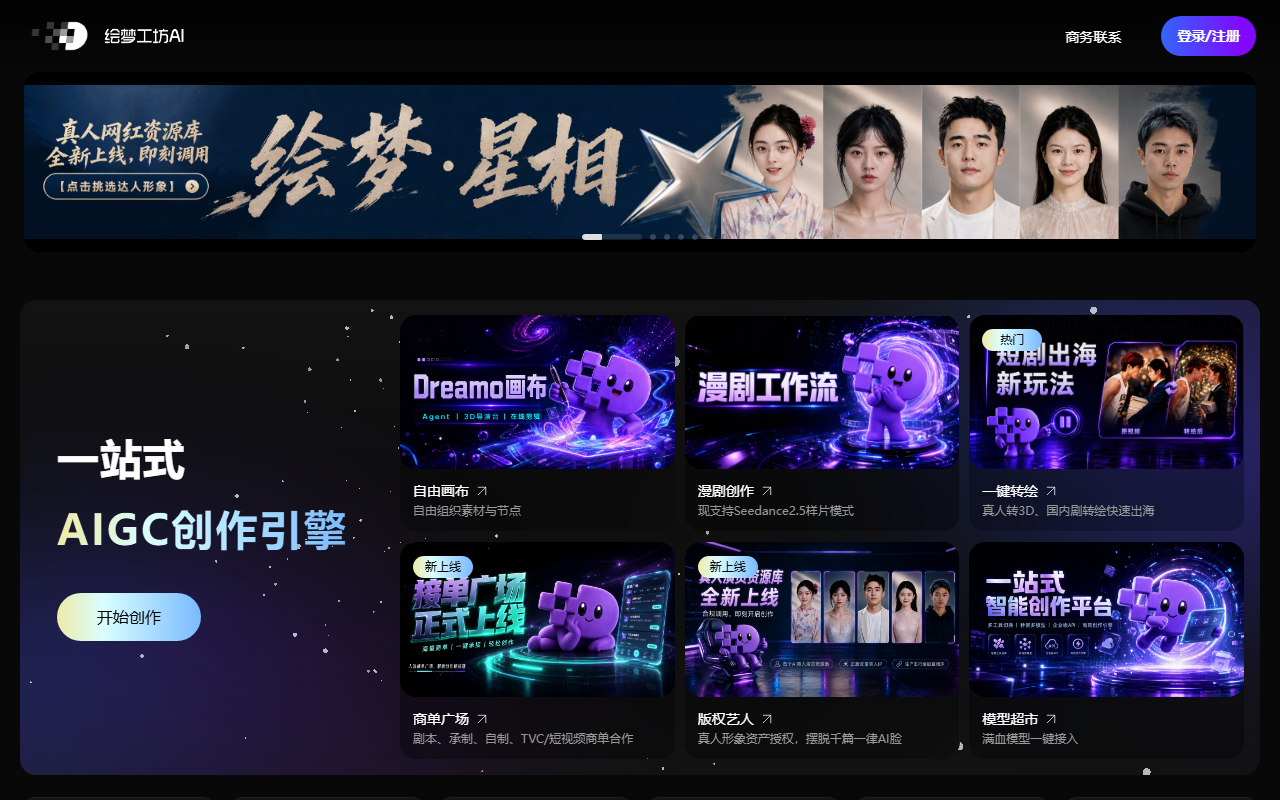
What Is Huimeng Workshop AI

Huimeng Workshop AI (绘梦工坊AI, official site: https://huimengi.com/) is a one-stop AIGC creation platform built for short dramas, comic dramas and commercial content production. It turns the path from script analysis to finished video export into a templated workflow, offers DreamoTV, a canvas where nodes can be freely wired together, and exposes a wide range of mainstream model capabilities through a separate API aggregation platform for individual creators, content teams and enterprise developers.
The platform consists of three product lines that work independently yet complement each other: the comic drama workflow handles long-form series and industrial-scale production, the DreamoTV free canvas handles custom generation pipelines and fine-grained parameter control, and the API aggregation platform brings video, image, audio and text models plus AI processing tools into a single entry point.
Main Capabilities
Comic drama workflow
- AI script analysis: imports long texts and scripts, then automatically maps character relationships, scenes, props, dialogue pacing and plot beats. Public materials indicate a single script can support roughly 50,000 characters of long-text parsing.
- Intelligent storyboard generation: splits shots based on scene transitions, character movement and emotional shifts, producing shot size, camera movement and duration.
- Character and scene asset library: character turnarounds, subject definitions and asset reuse reduce cross-shot and cross-episode face swapping and style drift.
- Multiple production modes: conventional detailed creation, mass-production mode and a more automated agent creation mode.
- Long-form project organization: designed for multi-episode serial content so characters, scenes, props, scripts and storyboards can be reused over time.
- Dubbing, scoring and smart editing: voice selection, lip-sync matching, subtitles, sound effects and background music.
- Team collaboration and permissions: members maintain projects and assets together for multi-person production.
- Distribution and commercialization: distribution partnerships, an order marketplace and copyright artist entries connect production with downstream distribution.
DreamoTV free canvas
- Node-based free building: add and connect assets, prompts, image generation, video generation and post-processing nodes as the project requires.
- Breaking fixed template limits: one canvas can serve comic dramas, short videos, e-commerce assets, commercial TVCs and creative shorts.
- Full-pipeline parameter control: visual style, camera movement, video duration, aspect ratio, first and last frames and generation method are all adjustable.
- Lightweight professional nodes: keeps the freedom of professional workflows while shortening the operation chain for beginners.
- Flexible multi-model switching: compatible with several mainstream AIGC models, selectable by quality, speed and cost.
- Official model capability: public materials state DreamoTV ships the full version of the official Seedance 2.0 and 2.5 API, with uncompressed capability, verifiable parameters and traceable sources.
- Asset reuse and reusable pipelines: generated images, videos, prompts and node combinations can be reused inside the canvas for revision and secondary creation.
API aggregation platform
- Multi-type model aggregation: video generation, image generation, audio models, text models and AI processing tools in one place.
- Mainstream video models: the public model marketplace lists Seedance 2.5, Seedance 2.0, Wan 3.0, MiniMax H3, HappyHorse, Kling V3 and Grok Video.
- Image and audio models: Seedream, Qwen Image, the Image 2 series, the NB series, plus Suno and Doubao audio generation.
- Text large models: DeepSeek, Qwen, Kimi, GLM, Gemini, GPT and Doubao for scripts, copy and agent workflows.
- AI tool calling: video frame rate adjustment, subtitle removal, video super-resolution, image super-resolution and human review pre-check.
- Open API and enterprise access: a unified API for websites, apps, SaaS products and internal production systems.
- Unified billing and model comparison: billed by second, image, call or token, with discounts, preferred and custom editions.
- Automated content production: chain text, image, video and audio models into automated workflows for batch generation, smart customer service, marketing assets and content hubs.
How to Use It
Option 1: comic drama workflow
- Visit https://huimengi.com/ , register and sign in.
- Create a comic drama project and choose detailed creation, mass-production mode or agent creation.
- Enter a story idea, paste novel content or upload an existing script.
- Let AI analyze characters, scenes, props and pacing to produce a story outline and first storyboard draft.
- Set the art style, build character turnarounds and scene assets, and lock the subjects reused by later shots.
- Adjust storyboards, prompts, shot duration and camera movement, then generate videos shot by shot or in batches.
- Configure voice, lip-sync, subtitles, sound effects and background music, then finish the audio-visual mix.
- Export the finished video or keep collaborating with your team; teams with distribution needs can contact official distribution partners.
Option 2: DreamoTV free canvas
- Open the Dreamo canvas on the official site and create an infinite canvas.
- Plan the node structure around the project goal instead of applying a fixed template first.
- Add script, reference image, prompt, style, character, scene and asset nodes.
- Connect image generation nodes and set style, ratio, character consistency and output specifications.
- Connect video generation nodes and set camera movement, first and last frames, duration, frame rate, aspect ratio and model.
- Repaint, replace, extend or rearrange nodes to refine the footage step by step.
- Add voice, music, subtitle and editing nodes to complete the full audio-visual chain.
- Save mature node combinations as reusable pipelines for later projects or standardized team production.
Option 3: API aggregation platform
- Visit https://api.huimengi.com/ to register a developer or enterprise account.
- Check model parameters and prices for video, image, audio, text and AI tools in the model marketplace.
- Use HuiChat, quick creation or the asset library to validate prompts, reference images and results.
- Obtain API access or apply for enterprise integration and embed the models into your own system.
- Call text, image, video and audio models through the unified interface to build automated production pipelines.
- Manage model selection, task queues, cost budgets, asset storage and content review in production.
Use Cases and Who It Is For
Typical scenarios include serialized AI short dramas and comic dramas, creative shorts and AI music videos, e-commerce product images and promotional videos, commercial TVCs and brand films, sample films for online-novel IP, live-action to animation conversion with overseas distribution, enterprise content hubs, and standardized team production.
It suits short drama and comic drama creators, independent creators and directors who want to design their own visual pipeline, MCN agencies and studios that need collaboration and batch production, e-commerce and brand teams producing commercial assets continuously, novel authors and IP owners who want fast screen adaptation, and developers and SaaS companies integrating multimodal models through an API.
Limitations and Notes
Huimeng Workshop AI is a cloud-based online platform: open the official site in a browser and generation runs in the cloud without consuming local computing power. It usually offers a registration trial or credit mechanism alongside membership, computing power or pay-as-you-go plans; prices vary by model, product line and promotional period, so the official site pages are authoritative. Paid members usually receive commercial licensing, but commercial rights depend on the specific product line, membership agreement, model license and asset sources; before publishing a drama, running ads or signing brand deals, check the platform's latest user agreement and commercial licensing terms. AI-generated content should still be reviewed by a human before release, and model availability and scheduling policies may change as the platform evolves.
Frequently asked questions
How are Huimeng Workshop AI, DreamoTV and the API aggregation platform related?
They are three product lines of the same platform. The comic drama workflow serves standardized long-form series production, DreamoTV serves free canvas creation, and the API aggregation platform serves developers and enterprises calling model capabilities.
Should I use the comic drama workflow or the DreamoTV canvas?
Choose the comic drama workflow for multi-episode short dramas and continuous comic drama production. Choose the DreamoTV canvas when you need to build a custom generation pipeline, control parameters precisely, or work on e-commerce assets, TVCs and creative shorts.
Is Huimeng Workshop AI free, and can generated videos be used commercially?
The platform usually offers a registration trial or credit mechanism alongside membership, computing power or pay-as-you-go plans, so check the official site for current pricing. Paid members usually receive commercial licensing, but rights depend on the product line, membership agreement, model license and asset sources, so review the latest user agreement and commercial licensing terms before commercial use.