iFLYTEK Xiaoshutong is a language app for children that pairs textbook audio with phoneme-level pronunciation scoring, AI scenario dialogues and English-Chinese translation, then sends learning records to a linked parent account.
iFLYTEK Xiaoshutong: Chinese and English practice for young learners
iFLYTEK Xiaoshutong is a language learning app from iFLYTEK aimed at primary and middle school children. It moves daily Chinese and English practice onto a phone or tablet and organises the work around five activities: listening, reading aloud, speaking, translation and progress tracking.
What separates it from a plain audio player is the feedback loop. Textbook audio, pronunciation scoring and learning records are connected, so a child reads a sentence and immediately sees a score together with the sounds that caused problems. Parents can then review that record on their own device.
Main features
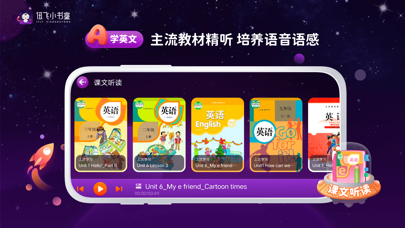
- Listen: officially licensed content from publishers, aligned with mainstream primary and middle school textbooks, to build familiarity with pronunciation and rhythm.
- Read: sentence-level read-aloud practice built on iFLYTEK pronunciation assessment, which can locate problems down to individual phonemes and suggest corrections. Coverage currently reaches about 90% of primary and middle school textbooks nationwide.
- Speak: AI scenario dialogues that recreate everyday situations, so children move from imitation to actual use.
- Translate: the same core translation engine used in iFLYTEK's handheld translator, supporting English-Chinese translation in both directions, by voice or by text, including mixed Chinese-English input; translated sentences can themselves be read aloud and scored.
- Track: learning data is visualised, and once a parent links an account they can follow results through WeChat and offer guidance.
How to use it
- Install the app from your phone or tablet app store, register, and choose the child's grade and textbook edition.
- Open the listening section, play the audio for the current unit, and listen once without reading to catch the rhythm.
- Switch to read-aloud practice, record sentence by sentence, and review the score and the flagged sounds; repeat the weak ones.
- Start a scenario dialogue and complete one round; use translation when a phrase is unclear, then say it again inside the dialogue.
- Link the parent account in the personal centre, then check the periodic record in WeChat and plan practice around the weak points.
Where it fits
- Primary school children reviewing textbook reading after class and correcting habits that have already become fixed.
- Middle school students practising English passages and everyday conversation when nobody is available to listen.
- Parents who want evidence of daily practice but have no way to assess pronunciation themselves.
- Learners who need a bilingual gloss of a sentence before repeating it, so new words stay attached to context.
Limits
- Content and assessment cover Mandarin Chinese and English; the app is not a general multi-language tutor.
- Scores depend on recording conditions. A noisy room or a weak microphone will lower results, so a quiet space helps.
- The app supports practice and feedback; it does not replace a teacher and cannot promise exam improvement.
- Textbook coverage depends on licensing, so availability of a specific edition should be checked inside the app.
- Parental viewing requires linking an account; without it, records stay on the child's device.
FAQ
Which ages is it designed for? It targets primary and middle school children, with content aligned to mainstream textbooks for both Chinese and English.
How detailed is the pronunciation feedback? Read-aloud practice can identify problems at phoneme level and point to a correction, with resources covering about 90% of primary and middle school textbooks nationwide.
How do parents see progress? After linking an account in the personal centre, parents can view their child's results through WeChat and use them to guide practice.
Frequently asked questions
Which ages is the app designed for?
It targets primary and middle school children, with content aligned to mainstream textbooks for both Chinese and English.
How detailed is the pronunciation feedback?
Read-aloud practice can flag problems at phoneme level and point to a correction, with resources covering about 90% of primary and middle school textbooks nationwide.
How do parents follow their child's progress?
After linking an account in the personal centre, parents can view results through WeChat and use them to guide practice.