PPIO Paiouyun is a distributed cloud platform that pools scattered GPU resources into one compute network, so developers can ship AIGC features through OpenAI-compatible APIs or on-demand GPU instances, while enterprises can opt for a dedicated private cluster.
What PPIO Paiouyun is
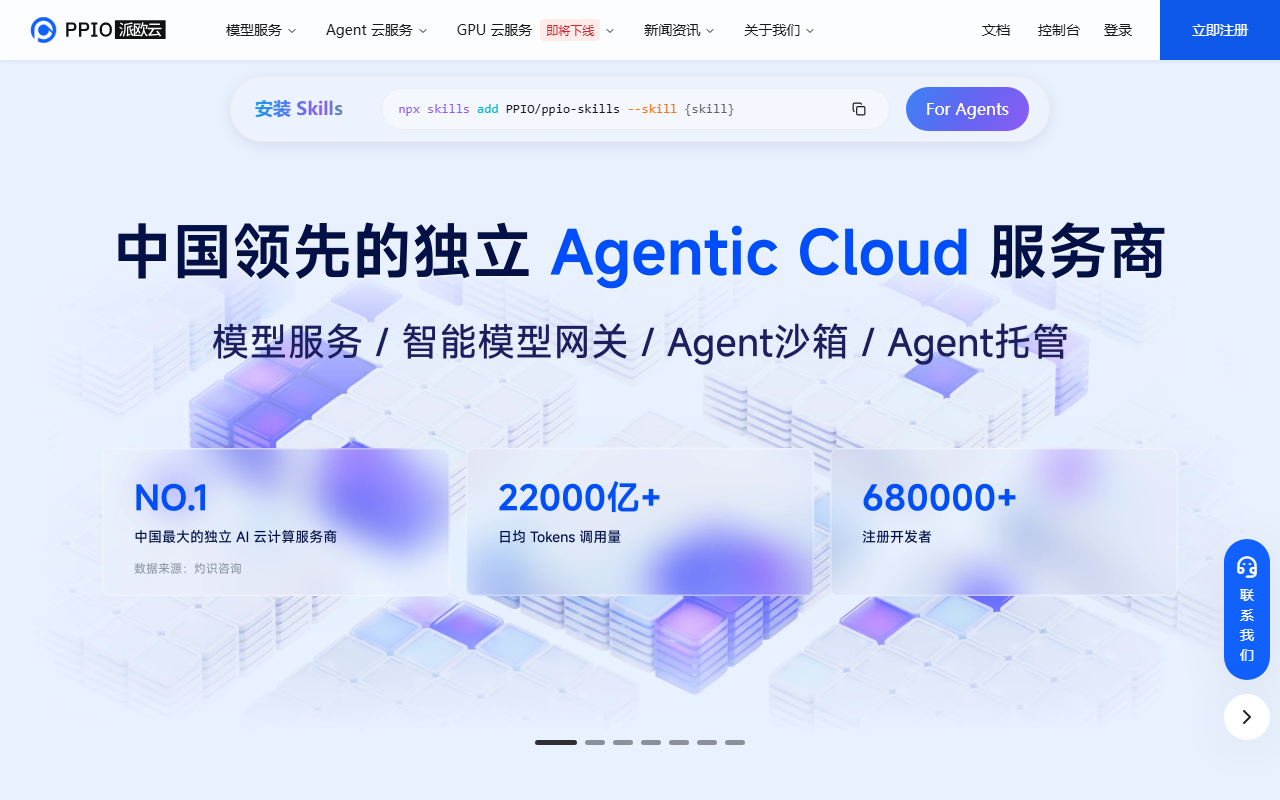
PPIO Paiouyun is a distributed cloud computing provider that gathers professional server capacity sitting at the network edge and in regional data centers into one shared compute network. It pairs a sharing-economy model with cloud-native and distributed computing technology, then delivers that capacity as AI inference APIs, GPU instances and industry solutions. Its main business lines are AI inference cloud, audio and video solutions, metaverse cloud rendering, and private deployment for enterprises. The official product site is ppio.cn.
Unlike a conventional cloud that mainly resells virtual machines from its own data centers, PPIO positions itself as a compute aggregator and scheduler. On one side it pools heterogeneous resources — hyperscale data centers, regional compute nodes and idle devices. On the other side it exposes them through a single console, a unified API and a custom inference acceleration engine. The platform also lists newer large models such as DeepSeek-R1-0528, which you can call through the API or try directly in the model playground.
Main capabilities
Model API service
The platform offers large language model APIs plus image and video generation APIs. Endpoints follow the OpenAI API standard, so in most projects the migration is a matter of changing the base URL, the API key and the model name, and existing OpenAI SDK code keeps working. PPIO states service stability of up to 99.9% and supports switching between multimodal models in seconds with inference acceleration, which helps teams that benchmark several models or mix text and visual generation in one product.
GPU cloud
GPU capacity comes in two delivery shapes. GPU container instances hand you containerized GPU resources with pay-as-you-go billing, ready-to-run images and one-click deployment — a good fit for training, fine-tuning and batch inference where you control the environment. Serverless GPUs target custom models with no infrastructure to operate, offering automatic scaling, load balancing and cold starts measured in seconds, which suits online inference whose traffic is spiky.
Audio and video solutions
Built on widely distributed edge nodes and years of media engineering, this line combines hardware, networking and media technology for long-form and short-form video on demand, entertainment live streaming, video calls and interactive live streaming. The pitch is a one-stop stack that keeps quality high, cost low and delivery stable.
Cloud rendering and metaverse
Using open-source professional graphics software on edge compute, the platform provides automatic deployment of cloud rendering for metaverse-style applications that need to render assets or frames remotely.
Enterprise private deployment
For companies that cannot send data to a shared cloud, PPIO offers a dedicated GPU cluster with fully managed operations, so the model serving stack runs in an environment the company controls while day-to-day operations stay with the provider.
How to get started
- Create an account on the official site with a phone number or account name.
- Verify your identity — personal or enterprise verification is required before compute and API access are enabled.
- Top up the balance from the account overview page; Alipay, WeChat Pay and corporate bank transfer are supported.
- Issue an API key in the key management page if you plan to call the API, and keep it out of front-end code and public repositories.
- Call a model — open the model playground, pick a model card, click the online trial panel and run a prompt with your parameters. To integrate, point an OpenAI-compatible client at the platform endpoint with your key and model name; Python SDK code can usually be reused as is.
- Launch GPU workloads — create GPU container instances or Serverless deployments from the console by choosing a specification, attaching an image or model, and setting scaling rules.
Where it fits
- Shipping AIGC products: chat, writing, image and video generation features that should not require running your own inference cluster.
- Video and live streaming: transcoding and delivery for on-demand, entertainment live and interactive streaming.
- Batch rendering: film, architectural visualization and metaverse scenes.
- Elastic capacity: spiky traffic or periodic training jobs that fit pay-as-you-go compute.
- Autonomous driving and research: workloads that need low latency, high bandwidth or large parallel compute.
Limits and things to check
- Figures such as 99.9% stability, second-level cold starts and instant model switching are vendor claims. They were not independently benchmarked here, so test with your own traffic before committing.
- Billing is prepaid plus usage-based, and identity verification is mandatory. Exact unit prices, free quotas and discounts come from the console and sales quotes; this article lists no prices.
- The model catalogue changes over time. Whether DeepSeek-R1-0528 and other models are available should be checked in the playground at the moment you need them.
- Audio/video solutions and private deployment are business-to-business engagements that normally go through a sales process rather than self-service signup.
- API keys are sensitive: a leaked key can generate real spend, so scope keys per project and rotate them.
FAQ
Is PPIO Paiouyun different from a normal public cloud GPU? A normal public cloud mostly sells instances from its own data centers. PPIO aggregates edge and regional heterogeneous capacity under a sharing-economy model and exposes it through one API and scheduling layer, so the same console gives you on-demand GPU instances, serverless deployments and OpenAI-compatible model APIs. That mix suits teams that want a hosted API today but may want their own inference stack later.
How much work is it to migrate a project that already uses the OpenAI SDK? Usually you change three settings: base URL, API key and model name. Business logic stays untouched. Run a regression pass in staging first, checking streaming output and tool calling, before moving production traffic.
Do I need a GPU instance for a small experiment? Start with the online trial in the model playground, then call the model API per token; that costs less than an always-on instance. Move to GPU container instances or Serverless when you need custom models, special dependencies or predictable latency.
Can a company keep model data in its own environment? Yes, through the dedicated GPU cluster plus fully managed private deployment option. Cluster size, network isolation and delivery timelines are agreed with sales.

Frequently asked questions
Is PPIO Paiouyun different from a normal public cloud GPU?
A normal public cloud mostly sells instances from its own data centers. PPIO aggregates edge and regional heterogeneous capacity and exposes it through one API and scheduling layer, so one console offers on-demand GPU instances, serverless deployments and OpenAI-compatible model APIs.
How much work is it to migrate a project that already uses the OpenAI SDK?
Usually three settings change: base URL, API key and model name. Run a staging regression that covers streaming and tool calling before shifting production traffic.
Do I need a GPU instance for a small experiment?
No. Try the model playground first, then call the model API per token, which costs less than an always-on instance. Choose GPU instances or Serverless when you need custom models or predictable latency.
Can a company keep model data in its own environment?
Yes, through the dedicated GPU cluster plus fully managed private deployment option; cluster size, network isolation and delivery timelines are agreed with sales.