Qianbi AI Rate Reducer is a text post-processing service: you upload a doc, docx or txt manuscript, its own models rewrite the phrasing, and the output is aimed at an AI detection rate below 20 percent and a similarity rate below 15 percent, with a human-assisted tier for results under 10 percent.
Qianbi AI Rate Reducer: A Post-Processing Service for AI Traces and Similarity Scores

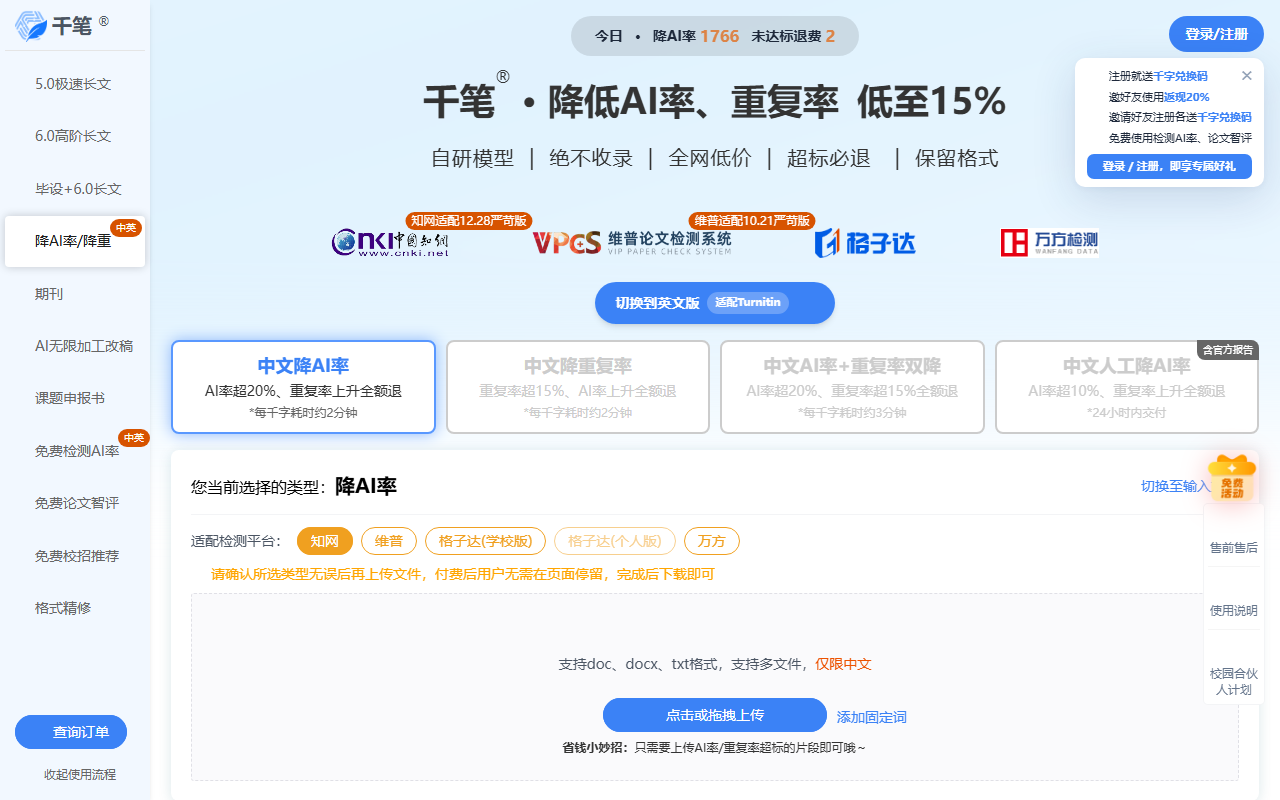
Qianbi AI Rate Reducer is an online text-processing service built around two problems that have become routine for anyone submitting written work to a screening system: the statistical fingerprint that AI-generated prose leaves behind, and the similarity score that accumulates when long documents are drafted from repeated sources. The platform runs its own models, tuned against widely used academic detection standards, and states two delivery targets: an AI detection rate below 20 percent and a similarity rate below 15 percent. Orders that miss those targets are eligible for a full refund.
It is worth being precise about what this tool is. It is not a writing assistant. It does not generate your draft. It sits after the draft and rewrites expression so the text reads and scores differently. Treating it as a finishing step rather than a starting point is the difference between using it well and wasting money.
The three service tiers
Work is sold as three separate options, each priced per thousand characters, so cost scales linearly with document length. A long thesis therefore costs substantially more than a short assignment, and estimating word count before ordering is genuinely useful rather than a formality.
- AI rate reduction at 3.33 yuan per thousand characters: rewrites sentence-level phrasing to push the AI detection score under 20 percent.
- AI similarity reduction at 3.99 yuan per thousand characters: restructures and paraphrases to bring the similarity score under 15 percent.
- Combined dual reduction at 5.99 yuan per thousand characters: applies both passes, intended for documents that must clear an AI check and a plagiarism check at the same time.
Detection standards and where they stop applying
The platform explicitly aligns with CNKI version 2.13 and Weipu (VIP) version 2.26. That alignment is the single most important thing to verify before paying, because detection algorithms are revised. A document that clears one version is not guaranteed to clear the next, and institutions frequently standardise on a specific edition.
If your school, journal or client uses a different edition, a different vendor, or an in-house system, confirm compatibility with the provider first. Do not assume that a result validated against one engine transfers to another. This is a limitation of the entire category of tools, not a defect unique to this one.
Turnaround and the human-assisted tier
Machine processing runs at roughly two to three minutes per thousand characters, which puts a ten-thousand-character manuscript in the region of twenty minutes of waiting. That is fast enough to fit into a single working session.
Above the automated tier sits a human-assisted option targeting an AI detection rate below 10 percent, delivered within 24 hours. Human editing buys more freedom in how sentences are rebuilt, at the cost of scheduling. Plan the buffer deliberately: ordering a few hours before a submission deadline defeats the purpose of a 24-hour service.
Refund terms and how to make them usable
The full-refund commitment applies when the AI rate or the similarity rate fails to reach the promised threshold. Its practical value depends on two things: which tool produced the verification, and what evidence you can present. Keep the detection report the platform returns, then re-check the output yourself with the same engine your institution uses. Where the two disagree, a documented comparison is what makes a refund conversation possible.
Files, privacy and sensible caution
Uploads accept doc, docx and txt, and text can also be pasted directly into the input field. Transmission and storage use encrypted infrastructure on Alibaba Cloud. Encryption addresses interception and storage, not editorial judgement, so documents containing unpublished research data, confidential commercial material or third-party secrets should be anonymised before upload. That rule applies to every online text service, not only this one.
Step by step
The workflow is short, and the order matters mainly because payment comes before processing.
- Open the official site, register and sign in.
- Choose AI rate reduction, similarity reduction, or the combined dual option.
- Upload a doc, docx or txt file, or paste the text directly.
- Check the service type, character count and price, then pay.
- Wait for processing, then download the rewritten text plus the AI-rate and similarity reports.
- Re-verify with the detection tool your institution recognises. If the result falls short of the promise, contact support with the report and request a refund.
- For a lower AI rate, select the human-assisted tier, which delivers within 24 hours.
Where it fits, and where it does not
The service suits final-stage preparation of dissertations and degree theses; chapters of journal submissions and research reports that exceed similarity limits; batches of marketing and social copy that must pass originality review; similarity reduction for translated academic text; standardisation of internal reports and business documents; and originality adjustment for student assignments and online course material.
It needs care where wording carries precise meaning. Machine rewriting can shift the accuracy of technical terminology, so every sentence of a methods section or a results discussion should be read back against the original. Legal instruments, medical instructions and regulatory filings tolerate almost no paraphrase drift. And any use that treats passing a detector as the goal, rather than producing honest work, is the wrong use: the tool belongs at the end of genuine effort, not in place of it.
One final note on framing. Lowering a detection score is a technical operation. The judgement about academic integrity stays with the institution, and no service can transfer that judgement elsewhere.
Frequently asked questions
How far can it lower the AI rate and the similarity rate?
The stated targets for automated processing are an AI detection rate below 20 percent and a similarity rate below 15 percent. The human-assisted tier aims for an AI rate below 10 percent and delivers within 24 hours. If the final figures miss the promised threshold, a full refund applies, so keep the detection report the platform returns as your evidence.
What does it cost and which file types are supported?
Pricing is per thousand characters: 3.33 yuan for AI rate reduction, 3.99 yuan for similarity reduction and 5.99 yuan for the combined option. Uploads accept doc, docx and txt, and text can also be pasted into the input box. Because billing follows character count, long manuscripts cost proportionally more, so estimate length before ordering.
How long does one document take?
Automated processing runs at about two to three minutes per thousand characters, so a ten-thousand-character manuscript typically finishes within roughly twenty minutes. The human-assisted option has a 24-hour delivery window. Avoid ordering in the final hours before a deadline, since you still need time to re-verify and adjust.
Which detection systems does it match, and will a pass stay valid?
The platform aligns with CNKI version 2.13 and Weipu version 2.26. Detection algorithms are revised over time, so clearing one edition does not guarantee clearing a later one. If your institution or journal uses another edition or another vendor, confirm compatibility before ordering rather than assuming a result carries over.
Is uploaded material kept private?
Transmission and storage use encrypted infrastructure on Alibaba Cloud. Even so, unpublished research data, confidential commercial documents and third-party secrets should be anonymised before upload, because encryption protects the channel and the store rather than the decision to share.