
SheepGeo suits corporate marketing departments, brand teams, SEO/GEO teams, website operators, content teams, and digital marketing teams that need to manage brand exposure in the AI era and track AI channel traffic and conversion.
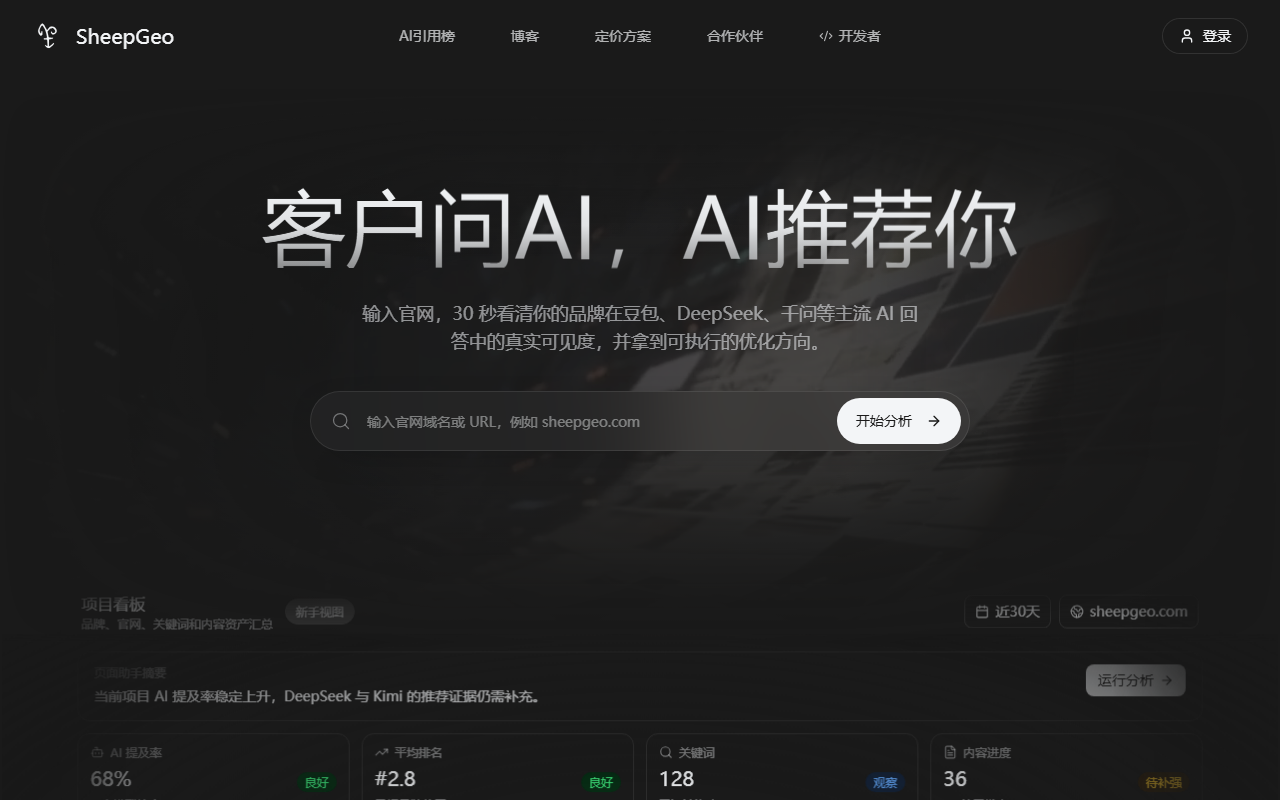
SheepGeo: A Generative Engine Optimization Analysis Platform for Chinese AI Models
SheepGeo is a GEO (generative engine optimization) analysis platform built for companies that need to manage brand exposure in the AI era. The problem it addresses is straightforward: users no longer look only at search result listings — they ask AI directly. When a prospective customer asks an AI assistant a question, is the brand recognized? Is it mentioned? Which position does it occupy? Whose sources does the answer cite? None of these could be measured reliably before. SheepGeo applies its proprietary five-dimension framework (referred to as the SHEEP framework) to deliver website GEO analysis, AI visibility checks, keyword penetration polling, brand monitoring, public opinion tracking, and AI traffic analytics, covering nine major mainstream Chinese AI models. You enter a URL or a brand term and receive quantified scores with optimization recommendations, plus continuous tracking of mention rates and ranking changes.
Main Features
Website GEO Analysis After you submit a URL, the system crawls the site automatically, checks for llms.txt, evaluates page performance, and measures AI visibility, then returns a five-dimension score together with an overall score. The llms.txt check is the most notable part of this analysis — it effectively acts as a site instruction sheet for AI systems.
AI Visibility Checks Checks can be run by website URL or by brand term, showing recognition rate, whether the brand is mentioned, its recommendation position, and which sources get cited across the nine major Chinese AI models. Recognition rate and recommendation position are two different metrics: being mentioned does not mean being placed at the front of the answer.
Keyword Penetration and Polling The system generates polling terms automatically and runs cross-model checks, then analyzes mention rate, first-position recommendation rate, and the gap against competing brands in different scenarios. Because the polling terms are generated by the system, measurement coverage does not depend on users enumerating every possible phrasing themselves.
Brand Monitoring Continuously tracks how often a brand appears in AI answers and how its ranking changes, and raises automatic alerts when a competing brand shows unusual movement.
Public Opinion Monitoring Collects brand-related content across the web, runs sentiment analysis and trend tracking, and alerts you as soon as negative information appears.
Report Center Consolidates multi-dimensional data into structured Word reports, with partial results available for export.
AI Traffic Analytics Identifies website visits coming from AI platforms and analyzes source distribution, visit depth, time on site, and conversion. This module connects the visibility metrics described above to actual business outcomes.
How to Use
- Register and log in: Create an account on the product site and sign in, then enable the capabilities covered by your permissions or plan in the console.
- Website analysis: Enter your official site URL in the website analysis module and submit the analysis task; the system generates a report in the background and shows progress in real time.
- Create a detection task: Create a detection task in the AI checks section by website or brand term, then review performance data across the nine AI models.
- Set up keyword penetration: Create a polling task in the keyword penetration module, where AI generates the polling terms for cross-model detection.
- Configure the monitoring center: Turn on brand monitoring and public opinion monitoring, set alert thresholds, and receive notifications when unusual fluctuations appear.
- Review and export reports: View results in the report center or in historical reports, export Word reports, and adjust content, structured data, and brand strategy based on the optimization recommendations.
- Track AI traffic: Review traffic data coming from AI platforms in the traffic analytics module and evaluate the effect of your optimization work.
Who It Is For
- Corporate marketing departments: Manage brand exposure in the AI era and make sure the brand is accurately recommended when customers ask AI questions
- Brand teams: Monitor how the brand is mentioned across AI models and track reputation signals to protect the brand image
- SEO/GEO teams: Professional optimization teams positioning brands for AI search scenarios and improving visibility inside generative engines
- Website operators: Improve site structure, llms.txt configuration, and page performance to raise how friendly the site is to AI crawlers
- Content teams: Adjust content strategy based on keyword penetration data to increase the likelihood of being cited and recommended by AI
- Digital marketing teams: Take full control of AI channel marketing performance and track AI traffic conversion and ROI
Limitations and Notes
- "First domestic" is an official positioning statement; you should verify actual market coverage yourself.
- AI model answers are inherently random, so the same question can return different results at different times or in different sessions. A single check result should not be treated as a stable conclusion — look at the trend across multiple samples.
- The coverage of the nine mainstream Chinese AI models depends on the platform's actual supported list; model updates or removals will affect the comparability of results.
- Brand monitoring and public opinion monitoring rely on public information collection, which has collection delays and coverage blind spots. An alert does not equal complete coverage.
- Reports and scores are intended for relative comparison and trend observation; they do not constitute a conclusion about a brand's actual market position.
- The platform crawls the target site and submits detection prompts to the AI models. Before doing so, confirm that this complies with your own website usage policies and applicable compliance requirements.
- Some capabilities must be enabled according to the plan; detection frequency and export scope are limited by permissions, so evaluate the cost before large-scale use.


Frequently asked questions
How is GEO different from traditional SEO?
Traditional SEO targets rankings in search results, while GEO targets answers produced by generative engines. When users ask an AI assistant directly, whether a brand is recognized, whether it is mentioned, which position it holds and whose sources the answer cites become new measurement dimensions. The recognition rate, mention status, recommendation position, and cited sources reported by SheepGeo are all designed around that difference.
Can AI visibility check results be trusted?
Treat them with care. AI model answers are inherently random, so the same question can return different results at different times or in different sessions; a single check should not be treated as a stable conclusion, and the trend across multiple samples is more meaningful. Platform coverage depends on the actual supported model list, and model updates or removals affect comparability. Reports and scores are better suited to relative comparison and trend observation.
What compliance points should I check before using SheepGeo?
The platform crawls the target site and submits detection prompts to the AI models, so confirm beforehand that this complies with your own website usage policies and applicable compliance requirements. Brand and public opinion monitoring rely on public information collection, which involves delays and coverage blind spots, so an alert does not mean complete coverage. Some capabilities must be enabled per plan, detection frequency and export scope are permission-limited, and cost should be evaluated before large-scale use.