Tago is less a general chatbot than a workbench for store operators. Six agents cover video production, browser-side tasks, video teardown, creator marketing, image batching and source-specific research, all driven by semantic instructions with live progress feedback. It fits repetitive, high-volume work such as launching new SKUs, producing creative assets, checking store pages and sending outreach at scale. The vendor highlights a preset e-commerce knowledge graph, awareness of platform differences and compliance constraints, and a self-learning loop fed by execution data. Public material does not disclose pricing, model providers, platform authorization mechanics or task quotas, and work touching account actions or content compliance still needs human review.
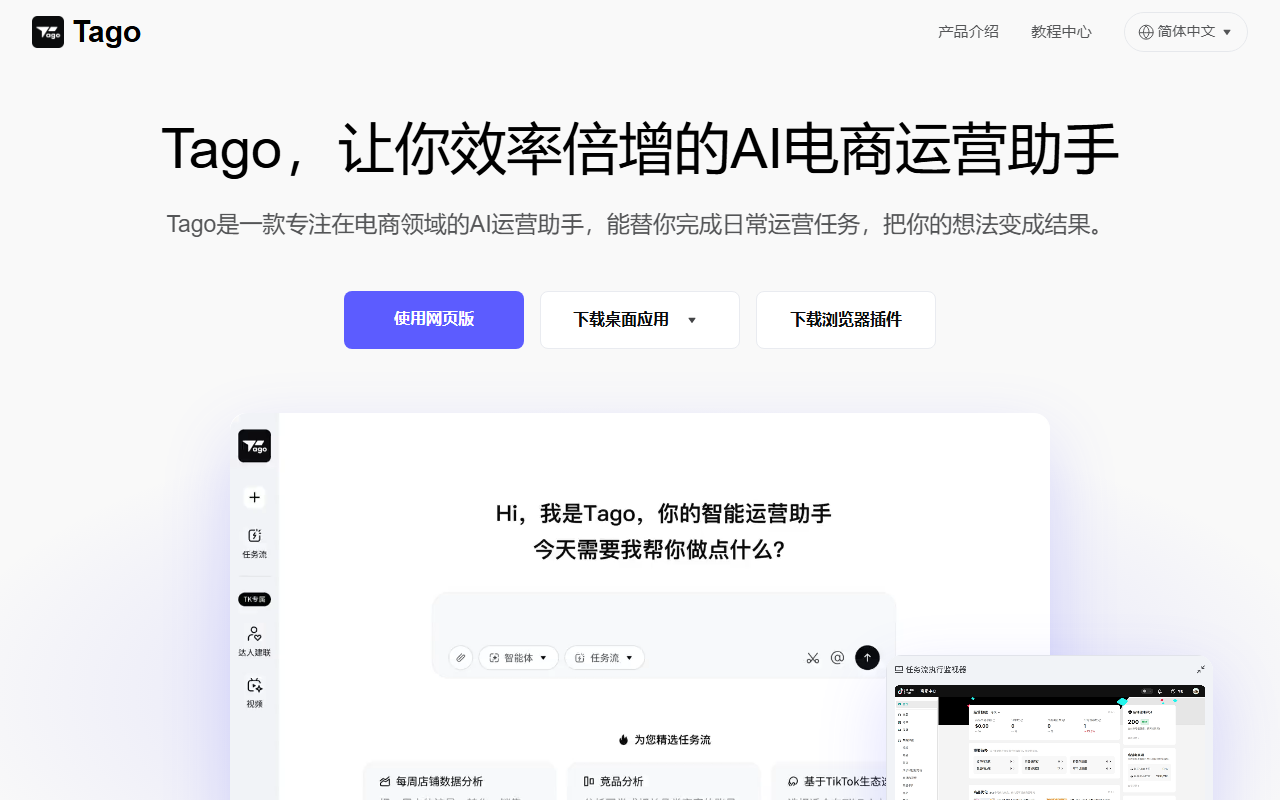
Tago: a multi-agent AI assistant built for e-commerce operations
An e-commerce operator's day is cut into small pieces. Morning: check the store for policy issues. Noon: three scripts for short commerce videos. Afternoon: outreach to dozens of creators. Evening: a competitor price sheet. None of it is hard, but all of it requires a person clicking through screens in sequence. What is scarce is not ideas but the hours to finish that chain of mechanical steps. Tago's approach is to hand those pieces to separate agents, with the operator stating only the goal and the system breaking it into steps. Whether it earns a place in your stack depends less on the length of the feature list than on whether each agent can reliably finish a full run, and whether a human notices quickly when it goes wrong.
According to the vendor, Tago is an AI operations assistant dedicated to e-commerce, running on a multi-agent architecture that dispatches work to different roles to carry a task from idea to result. Rather than one all-purpose chat box, it slices by operational function: video, web, video analysis, creators, images and research each get an agent that can be called on its own. The advantage is clear boundaries, so a failure in one area does not drag down the others; the cost is that stitching several stages together is left to you.
Three shared capabilities sit underneath those agents: a preset e-commerce knowledge graph so business semantics, platform differences and compliance constraints are recognized; automatic decomposition, sequencing and execution with live progress after a semantic instruction; and a self-learning loop fed by data flowing back from execution. The vendor also claims over eighty percent of routine mechanical hours can be freed. That figure is a vendor statement, and real savings track how standardized your tasks are and how stable the platform interfaces remain, so treat it as a direction rather than a guarantee.
What each of the six agents does
Commerce video agent
Batch production of short selling videos, covering the chain from script breakdown to finished video. The vendor stresses low cost and volume, which suits catalogs that need assets per SKU. Note that batch output still needs spot checks for voiceover, subtitles and visual consistency, and rules on labeling AI-generated content vary by market.
Web automation agent
Handles repetitive browser work such as store inspections, information updates and policy lookups. Its value is stability: when a page layout changes, automation breaks. The vendor calls the efficiency gain significant, but public material does not say which platforms are supported, how logins are authorized, or how captchas and risk controls are handled, and those are exactly the parts that consume time in practice.
Video analysis agent
Tears down published or competitor videos into script analysis, selling-point extraction and comment analysis. For content commerce this converts a vague sense that a video works into a reusable structure: how the opening hooks, at which second the pitch lands, what the comments question.
Creator management agent
Manages the creator marketing workflow at volume, from gathering creator data to sending invitations and evaluating results. This is the most labor-heavy step in operations, full of spreadsheets and direct messages. Automation removes repeated entry and first-pass screening, but terms, pricing negotiations and disputes still need a person, and fully automated outreach is not advisable.
Product image agent
Batch processes product images with optimization, prohibited-claim checks and bulk editing. The compliance check is the underrated part: platforms differ in how strict they are about visual claims, and machine screening lowers takedown risk while final judgment still follows platform rules.
Data research agent
Works as a browser assistant to analyze and research specified sources, supporting competitor monitoring and market trend analysis. Its boundary is the phrase specified sources: the credibility of the output depends on source quality, so treat it as decision input rather than a conclusion.
Getting started
- Visit the official site, register and sign in, and check which modules your account can see, since availability may differ.
- Pick the module that matches the problem in front of you, for example the image and video agents during a product launch.
- Write a specific instruction in that module: category, platform, target audience and delivery format. Vague instructions directly lower output quality.
- Run the task and watch the live progress; stopping early when the direction is wrong costs less than redoing a finished run.
- Review the generated video, report or processed image, and do one human pass against platform rules.
- For full functionality or long-running work, install the Windows or Mac client, or the browser extension so web automation runs inside a session you are already signed into.
Who it suits
- E-commerce teams with many SKUs and heavy asset demand, especially groups that must ship images and clips on a platform's launch cadence.
- Short-video operators in content commerce who want to turn winning structures into reusable script templates through teardown.
- Creator marketing roles handling large volumes of creator data, screening and outreach records who want that work out of spreadsheets.
- Selection or market roles that track competitor pricing and trends on a schedule and can hand fixed sources to a browser assistant.
Prerequisites and limits
- Public material does not disclose pricing, free quota or per-agent task limits, nor model providers and inference costs, so budget must be confirmed directly.
- Web automation touches store backends and login permissions, and the vendor does not document the authorization mechanism, captcha handling or risk-control behavior; real usability depends on the platform you operate.
- The eighty percent automation claim is the vendor's own, without third-party verification, and savings shrink as tasks become less standardized.
- Generated video, copy and image claims need review against platform rules and local law, especially AI labeling, absolute wording and efficacy claims.
- Research is bounded by the sources you specify; when sources are incomplete the conclusions skew, so it should not be the sole basis for pricing or media decisions.
Frequently asked
How is Tago different from a general AI assistant?
A general assistant answers with advice. Tago runs work through function-specific agents and returns usable artifacts such as videos, processed images and reports rather than a paragraph of suggestions.
Do I need a store before using it?
Video, image and video analysis modules do not depend on a store backend; web automation and research only become efficient once a platform account is connected.
Can generated videos go straight into ad delivery?
Not advisable. Batch assets need spot checks for visual and voiceover consistency and must meet the delivery platform's creative rules and AI labeling requirements first.
How reliable is the research output?
It depends on the sources specified. It suits competitor monitoring and early trend reads, while key numbers such as price and share should be checked against the original pages.
Will it replace operators?
It replaces repeated actions more than people. Assortment judgment, campaign rhythm, creator negotiation and exception handling stay human; the tool removes the execution chores in between.
Frequently asked questions
How is Tago different from a general AI assistant?
A general assistant answers with advice. Tago runs work through function-specific agents and returns usable artifacts such as videos, processed images and reports rather than a paragraph of suggestions.
Do I need a store before using it?
Video, image and video analysis modules do not depend on a store backend; web automation and research only become efficient once a platform account is connected.
Can generated videos go straight into ad delivery?
Not advisable. Batch assets need spot checks for visual and voiceover consistency and must meet the delivery platform's creative rules and AI labeling requirements first.
How reliable is the research output?
It depends on the sources specified. It suits competitor monitoring and early trend reads, while key numbers such as price and share should be checked against the original pages.