FastGPT is an enterprise platform for building AI agents. You wire nodes together on a canvas, connect a knowledge base search step to an AI conversation step, pick a model such as ChatGPT, Claude, DeepSeek or Baidu ERNIE, and publish the result as a no-login page, an API, or an IM bot. It is aimed at internal knowledge Q&A, customer support and repeatable business automation.
FastGPT: Build Enterprise AI Agents with Visual Workflows and RAG Knowledge Bases
FastGPT addresses a specific gap: companies already store policies, product manuals and support tickets as documents, yet an employee who needs one sentence still has to browse folders, ask a colleague, or trust a keyword search. The platform first turns those documents into a searchable knowledge base, then chains retrieval, reasoning and answering into one visual workflow, and finally publishes that workflow as an entry point people actually open. Most of the assembly is drag-and-drop.
Three parts share one interface. The knowledge base prepares documents, database records and API data as retrievable material. The workflow decides what happens to a question: classify the intent, retrieve, judge whether a human is needed, then answer. The model layer turns retrieved passages into prose. Because the responsibilities are separated, a wrong answer can be traced to a specific stage instead of blamed on the model.
The positioning is internal tooling rather than a demo toy. Team spaces, shared workflows and unified asset management for knowledge bases and variables look unglamorous, but they are the precondition for a prototype becoming a department-level tool: who edited a flow, which applications reference a knowledge base, where a variable is reused. The source page does not disclose pricing, per-tier quotas or data residency, so confirm those with the vendor before committing.
Main features
Visual workflow building
Drag nodes and draw connections to build data flow and task automation without writing code. It suits multi-step logic such as look up the material, classify the request, then answer from a template, and teammates can read the diagram without opening a code editor.
Knowledge base with RAG retrieval
Internal documents, databases and APIs become a knowledge base that grounds the answers. Retrieval means replies point back to actual material instead of relying on model memory, but chunking strategy and document quality decide how well it works, so expect tuning.
Multiple model providers
ChatGPT, Claude, DeepSeek and Baidu ERNIE are listed as supported models. Choosing per task lets you keep cheap models for simple FAQ traffic and reserve stronger models for reasoning-heavy steps.
Prebuilt AI components
Conversation, knowledge base search, question classification and document parsing arrive as ready nodes. Packaged capabilities cut repetitive assembly and let non-developers take part in designing a flow.
Ecosystem integrations
Connect Feishu, DingTalk, WeCom and various databases so the assistant lives where employees already work. Integration is really about lowering the cost of opening the tool, and usage tracks that cost.
In-conversation intent routing
A chatbot can route different intents to different workflows, interact with the user mid-flow, ask for confirmation, and fall back when intent recognition is unsure. When several businesses share one entry point, this step decides whether users land in the right flow.
Content collection and processing
Web page scraping, Markdown to file conversion, trending-list retrieval, text extraction and Base64 encoding are offered as one content pipeline. Useful for news digests or competitor monitoring where data has to be pulled continuously.
Toolbox and MCP extension
Code execution, HTTP requests, conditional branching and batch execution ship built in, and custom capabilities can be added through protocols such as MCP. This is the escape hatch when a standard node cannot cover a requirement.
Team collaboration and assets
Team spaces, shared workflows and centralised management of knowledge bases and variables support collaboration and automated operations. When several people edit one flow, clear asset boundaries matter more than feature count.
How to use it
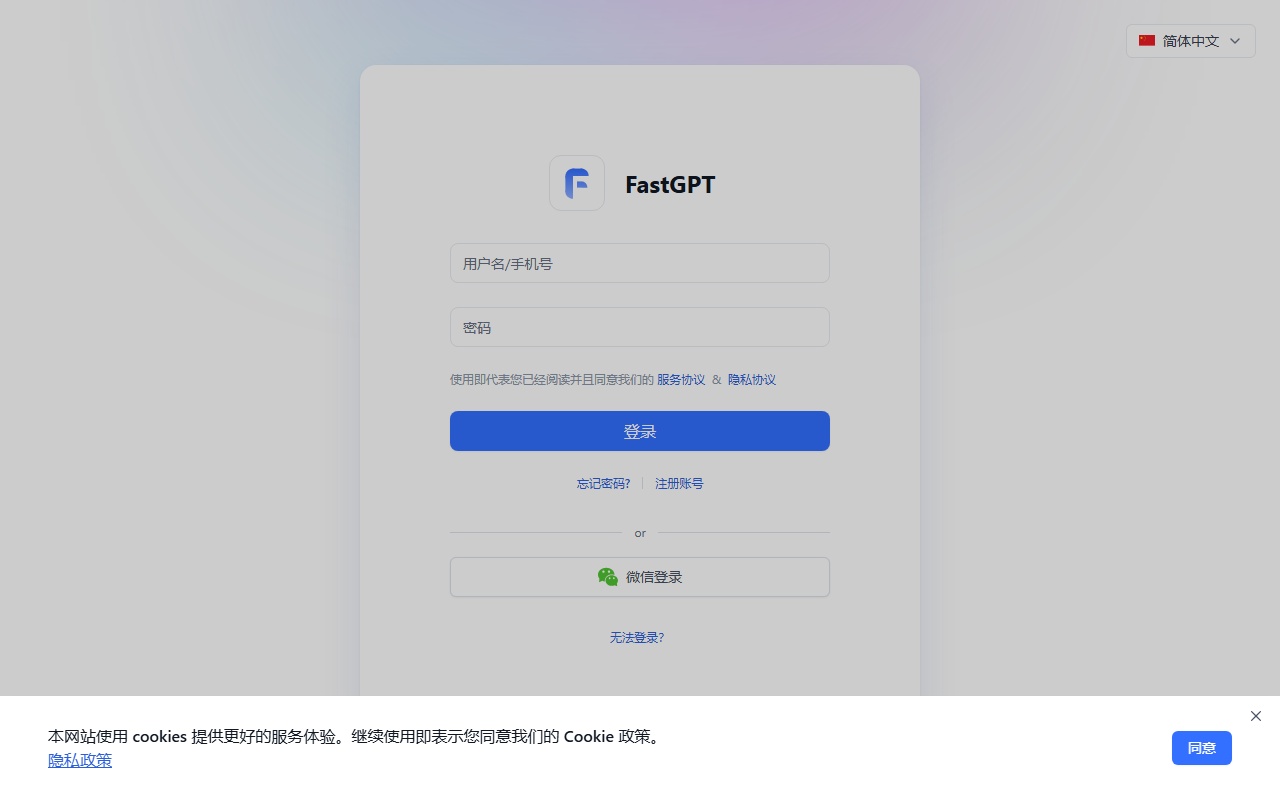
- Visit the FastGPT website, register and sign in to reach the workspace.
- Open the knowledge base section and import the documents you prepared, then wait for parsing and indexing to finish.
- Go to the workspace, create a new workflow and give it a name; you get an empty canvas.
- Add a knowledge base search node and point it at the imported base, then add an AI conversation node, connect the two and configure the model and prompt.
- Run the preview and ask your own questions to check whether retrieved passages and the final answer line up.
- Publish to a no-login page, an API, a Feishu or DingTalk bot, or a WeChat Official Account.
Who it fits
- Admin and HR teams turning policies, expense rules and onboarding guides into a Q&A entry point.
- Operations and support teams capturing scripts and ticket history for smart replies, routing and sentiment alerts.
- Developers packaging repetitive API orchestration, data cleanup and report generation into reusable flows.
- E-commerce and training businesses handling orders, inventory and course enquiries at high volume.
Limitations to know
- The source page does not disclose pricing, free quota, tier differences or data residency; confirm with the vendor first.
- Answer quality depends heavily on how documents are chunked and how often they are refreshed. Stale documents produce confidently wrong answers.
- Retrieval guarantees that a passage can be found, not that the conclusion is correct; finance, legal and medical outputs still need human review.
- The listed scenarios are broad, and the source page offers no public quantitative case studies for specific industries.
- Third-party model calls add cost and compliance review, including any rules on cross-border data transfer.
FAQ
Does FastGPT require coding?
Not for basic flows. Drag-and-drop nodes cover knowledge base Q&A and intent routing. Code execution, HTTP requests and custom parameter handling still assume some technical skill.
How is it different from calling a model directly?
A direct call relies on the model's own memory. FastGPT inserts a retrieval step so answers rest on your documents, and the workflow layer controls multi-step logic, branching and external system calls.
Which models can it connect to?
The source lists ChatGPT, Claude, DeepSeek and Baidu ERNIE among mainstream options. Actual availability, parameters and billing depend on how the platform is configured.
Where can a finished agent be published?
As a no-login page, an API, or a bot inside Feishu, DingTalk or WeChat Official Accounts, so staff can ask questions inside tools they already use.
What data sources can a knowledge base hold?
Documents, databases and APIs are all mentioned. The exact supported file formats and per-file size limits are not itemised on the source page.
Frequently asked questions
Does FastGPT require coding?
Not for basic flows. Drag-and-drop nodes cover knowledge base Q&A and intent routing. Code execution, HTTP requests and custom parameter handling still assume some technical skill.
How is it different from calling a model directly?
A direct call relies on the model's own memory. FastGPT inserts a retrieval step so answers rest on your documents, and the workflow layer controls multi-step logic, branching and external system calls.
Which models can it connect to?
The source lists ChatGPT, Claude, DeepSeek and Baidu ERNIE among mainstream options. Actual availability, parameters and billing depend on how the platform is configured.
Where can a finished agent be published?
As a no-login page, an API, or a bot inside Feishu, DingTalk or WeChat Official Accounts, so staff can ask questions inside tools they already use.