Miaoda is a no-code application development platform from Baidu. Without a programming background, you describe what you need in natural language and it generates a runnable web page, mini program, or app, which suits personal projects, internal business systems, and lightweight tools.
Miaoda: A No-Code Platform That Builds Web Pages, Mini Programs, and Apps From Plain Language
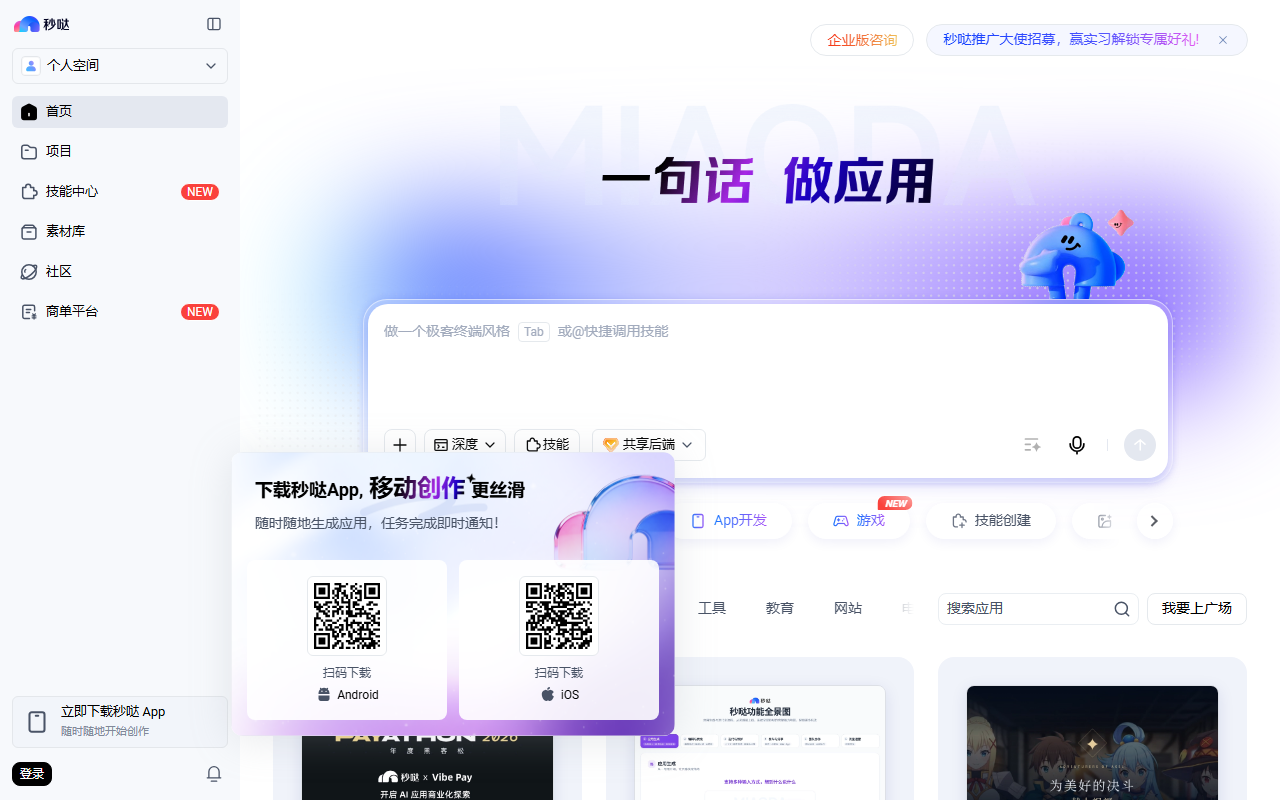
Miaoda is a no-code application development platform from Baidu. You do not need a programming background: describe what you want in natural language and the platform generates a working web page, WeChat mini program, app, or data tool. The idea is to hand the engineering work between "explaining what you need" and "getting something that runs" to AI, so people who do not write code can still go from an idea to a published product. The platform also includes a skills center, a shared backend, an asset library, and a template community, plus voice input and a deep mode for more complicated requests.
Key Features
Build an app from one sentence: Enter a natural-language description and the platform generates a runnable web page, mini program, or app.
Skills center: Built-in AI skills cover data analysis, slide generation, image generation, and video generation. They can be invoked with a short command, and you can also create your own.
Shared backend: Several apps can use the same backend capabilities, which lets them share data and reuse functions instead of rebuilding the same plumbing.
Deep mode: For complex requirements, enabling deeper reasoning produces a more complete structure and more coherent logic.
Multiple output targets: The same requirement can be generated as a web page, a WeChat mini program, an app, or another form.
Voice input: Requirements can be described by voice, which helps when typing a long brief is inconvenient.
Template marketplace: Templates created by other users can be used as-is or modified further.
Asset library: Images, icons, and audio are managed in one place so apps can call on them.
Community publishing: Finished work can be submitted to the marketplace for other users to visit and use.
Enterprise options: Private deployment, permission management, and technical support are available for teams and companies.
How to Use It
Sign up and sign in: Go to the Miaoda site at miaoda.cn, register, and sign in to reach the development interface.
Describe the requirement: In the input box on the home page, explain what you want in plain language, for example "make a to-do list web page."
Call skills quickly: While typing, use @ or Tab to invoke built-in skills such as data analysis or image generation.
Pick an output type: Switch between web page, mini program, and app development modes as needed.
Turn on deep mode: When the app logic is complicated, deeper reasoning trades time for a more complete structure and flow.
Start from a template: Browse the marketplace and modify an existing template rather than starting from nothing.
Manage assets: Upload and organize images and audio in the asset library so apps can reference them.
Publish and share: Submit the finished app to the marketplace for others to visit and use.
Continue on mobile: With the Miaoda app installed, you can check progress, manage projects, or keep editing on a phone.
Typical Uses
Turning personal ideas into tools: Convert an idea into a usable personal tool or small project without learning to program first.
Internal business systems: Build CRMs, project trackers, or operations automation, shortening the gap between a requirement and something usable.
Education and learning: Produce custom learning tools or teaching pages for classroom and self-study use.
Marketing and campaigns: Assemble landing pages, sign-up forms, or lightweight marketing tools and share them across channels.
Mini programs and lightweight apps: Generate WeChat mini programs and similar forms that pair with online and offline business.
Limitations to Keep in Mind
Results depend on how well the model understands the request. Vague descriptions lead to more rework, and complex business logic usually needs several rounds of adjustment.
A no-code platform covers common shapes well, but unusual architectures, extreme performance needs, or deep customization may still call for conventional development.
The available skills, shared backend features, template count, and output formats change between versions; what the platform actually offers at the time is what applies.
If a generated app handles user data, payments, or public release, you are responsible for confirming compliance requirements and the corresponding configuration.
Pricing is based on resource consumption or call volume, and allowances differ by plan, so it is worth reading the billing rules before relying on the platform.
FAQ
What is Miaoda?
It is a no-code application development platform from Baidu. You describe what you need in natural language and it generates a web page, WeChat mini program, app, or data tool.
Do I need to know how to program?
No. The main workflow is describing the requirement in plain language and letting the platform generate the app. For complex logic you can enable deep mode or iterate over several rounds.
What kinds of apps can it produce?
Web pages, WeChat mini programs, apps, and data tools, among other forms, so one requirement can be delivered for different targets.
Frequently asked questions
What is Miaoda?
It is a no-code application development platform from Baidu. You describe what you need in natural language and it generates a web page, WeChat mini program, app, or data tool.
Do I need to know how to program?
No. The main workflow is describing the requirement in plain language and letting the platform generate the app. For complex logic you can enable deep mode or iterate over several rounds.
What kinds of apps can it produce?
Web pages, WeChat mini programs, apps, and data tools, among other forms, so one requirement can be delivered for different targets.