
MonkeyCode is an open-source AI coding assistant and enterprise platform from Chaitin Technology. The entry point is the repository comment thread: mention the AI engineer in a pull request or issue, get a reply the source puts within 30 seconds, then receive code generation, optimisation or review for a plain-language requirement. It supports local-plus-cloud environments, Specification-Driven Development, GitHub, GitLab, Gitea and Gitee integration with private deployment, and models such as OpenAI Codex and Claude Code, with 20,000 compute credits for new accounts. Pricing and licence details are not disclosed.
MonkeyCode: an open-source AI coding assistant you summon with a mention in a pull request
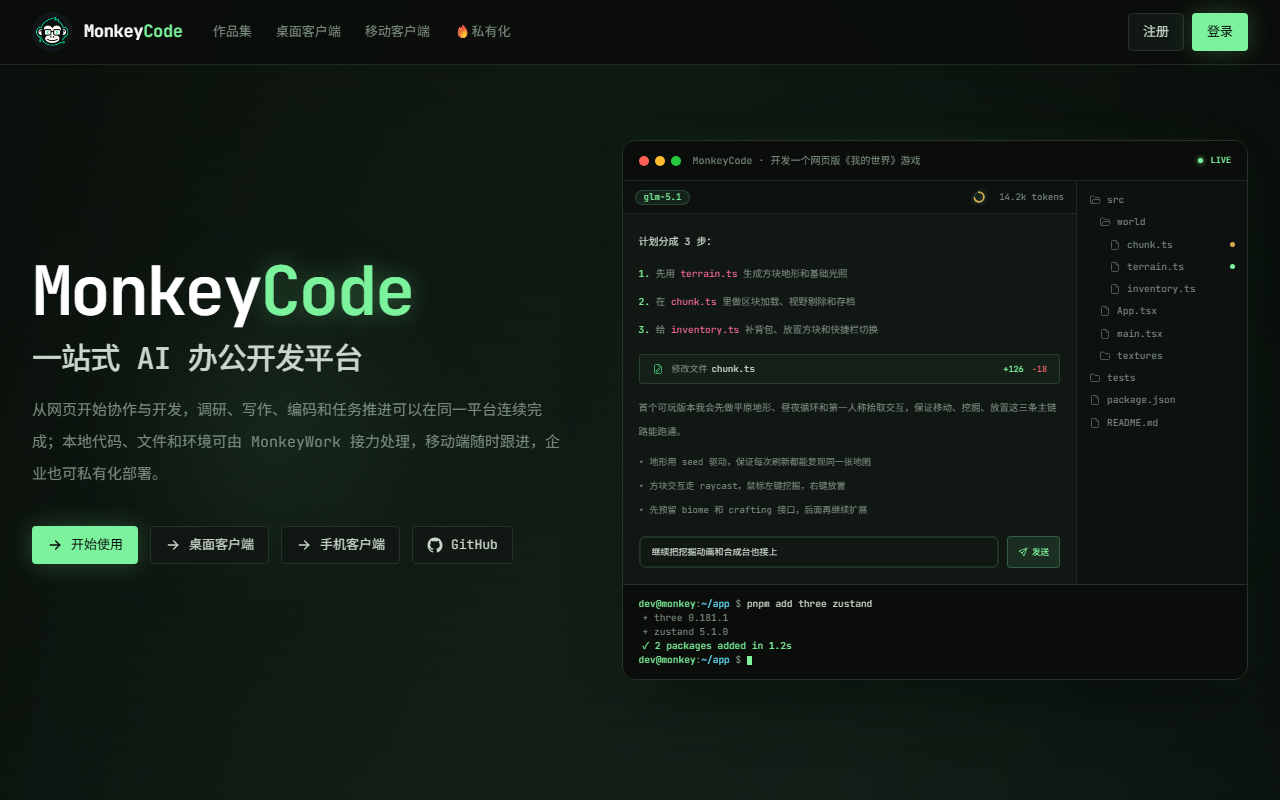
MonkeyCode is an open-source AI coding assistant and enterprise development platform from Chaitin Technology, aimed at engineering collaboration and management. It does not ask teams to install a plugin or switch editors; it lives in the comment thread of the code host. Mention the AI engineer in a pull request or issue, wait for a reply that the source puts within 30 seconds, and it delivers code generation, optimisation or review. The platform also combines local development machines with cloud control, supports Specification-Driven Development, integrates with GitHub, GitLab, Gitea and Gitee, and can be deployed privately.
The delivery model is the unusual part. Most AI coding tools require the team to adopt a new editor or extension; MonkeyCode puts the entry point inside the repository itself, in pull request and issue comments. For a team already on GitHub or GitLab the integration cost is close to zero: no toolchain change, no convincing everyone to adopt new habits, just try it in one repository first.
The second design layer is Specification-Driven Development. Code generation is driven by a formal specification, so the spec comes before the implementation. That matters in enterprise settings: generating fast once is not remarkable, and output without a specification constraint loses focus quickly in multi-person collaboration and long-term maintenance. Putting the specification first writes consistency into the process.
The third layer is how it runs. Local development machines and cloud control can be combined, and the platform supports both online use and private deployment while staying compatible with mainstream models such as OpenAI Codex and Claude Code. New accounts receive 20,000 compute credits, which the source labels a limited-time offer. The limits worth naming: pricing, how credits convert to usage, team seats, concurrency ceilings and the data retention policy for generated code are not disclosed, so verify them before scaling.
Core features
Flexible, secure development environment
Local machines and cloud control combine, so code does not have to move wholesale to a public cloud while central governance is preserved. For teams with compliance requirements this outweighs raw model capability.
Natural language development
Tasks are issued in plain language and the AI performs the development actions, lowering the barrier to entry. Good for repetitive refactors, filling in tests and fixing small defects.
Specification-Driven Development
Code generation follows a formal specification: interfaces and behaviour are agreed first, then the implementation is produced. In team work the specification becomes the shared basis for review and the manual for later maintenance.
Deep Git platform integration
Integrations with GitHub, GitLab, Gitea and Gitee, available online or privately deployed, embed the assistant in the existing workflow without migrating repositories.
Broad model compatibility
Supports mainstream AI coding models including OpenAI Codex and Claude Code, so a team can pick the underlying model by task type and data compliance needs.
New-user compute credits
Registration includes 20,000 compute credits, labelled a limited-time benefit in the source. The conversion rate and validity period are not explained.
How to use it
- Open the MonkeyCode website and register an account.
- Go to the repository you want to work on and mention the AI engineer in a pull request or issue comment.
- Wait for the reply; the source describes a response within 30 seconds of the message.
- Describe the requirement in plain language, including expected behaviour, boundary conditions and the parts that must not change.
- Take the result, whether generated code, optimisation or review notes, and merge it through your normal review process.
Where it fits
- Code generation and optimisation: produce a first implementation quickly, or improve the readability and quality of existing code.
- Architecture and technical design: use the specification-first mode to write requirements as a spec and derive architecture and technology choices from it.
- Code review and risk detection: surface potential risks with improvement suggestions as a pre-filter before human review.
- Collaboration inside the Git platform: interact in pull requests and issues so discussion and change stay in one place.
- Multi-role teamwork: product managers, project managers and engineers work on requirements and implementation in one flow.
- Individual learning: treat the AI as a pairing partner and watch how it breaks a problem down.
Limits and cautions
- The source does not disclose pricing, paid tiers or how compute credits convert; the 20,000 credits are a limited-time benefit whose validity and consumption rules must be confirmed on the site.
- It is described as open source, but the specific licence, which components can be self-hosted and the hardware requirements for private deployment are not stated.
- Model compatibility follows the source description. The models actually available depend on deployment configuration and account permissions and may not all be selectable.
- Mention-based triggering relies on the code host comment thread, so the repository needs the relevant permissions and integration setup; the permission model is not described.
- Team seats, concurrent task counts and behaviour under load are not disclosed; 30 seconds is a first-response figure, not a service level commitment.
- Generated code needs human review. The source does not describe retention, training use or deletion policies for code and prompts, so confirm them before using it on sensitive repositories.
Frequently asked questions
How do I start?
Register, then mention the AI engineer in a pull request or issue comment; the source describes a reply within 30 seconds, after which you describe the task.
Which code hosts are supported?
The source lists GitHub, GitLab, Gitea and Gitee, with both online use and private deployment.
Is it free?
New accounts receive 20,000 compute credits, labelled a limited-time benefit; paid plans and prices are not disclosed.
Which underlying models are supported?
The source mentions mainstream AI coding models such as OpenAI Codex and Claude Code; the actual range depends on deployment and permissions.
Frequently asked questions
How do I start?
Register, then mention the AI engineer in a pull request or issue comment; the source describes a reply within 30 seconds, after which you describe the task.
Which code hosts are supported?
The source lists GitHub, GitLab, Gitea and Gitee, with both online use and private deployment.
Is it free?
New accounts receive 20,000 compute credits, labelled a limited-time benefit; paid plans and prices are not disclosed.
Which underlying models are supported?
The source mentions mainstream AI coding models such as OpenAI Codex and Claude Code; the actual range depends on deployment and permissions.