Nile is an agentic commerce backend that gets brands into AI shopping channels quickly: after connecting Shopify, a feed, CSV, or API, it automatically syncs catalog and inventory, rebuilds product context that AI can read, matches purchase intent at entry points such as ChatGPT, Perplexity, and Gemini, and routes orders back to the merchant's existing checkout and fulfillment flow.
Answer in one sentence
Nile is an agentic commerce backend purpose-built for the Agent era. The core value is not building another standalone store; instead, it compiles the brand's existing products, reviews, and story into structured context that AI can understand, so products enter the search, comparison, and purchase flows of ChatGPT, Perplexity, Gemini, and other agents — while the merchant keeps its own checkout, customers, and data.
Product positioning
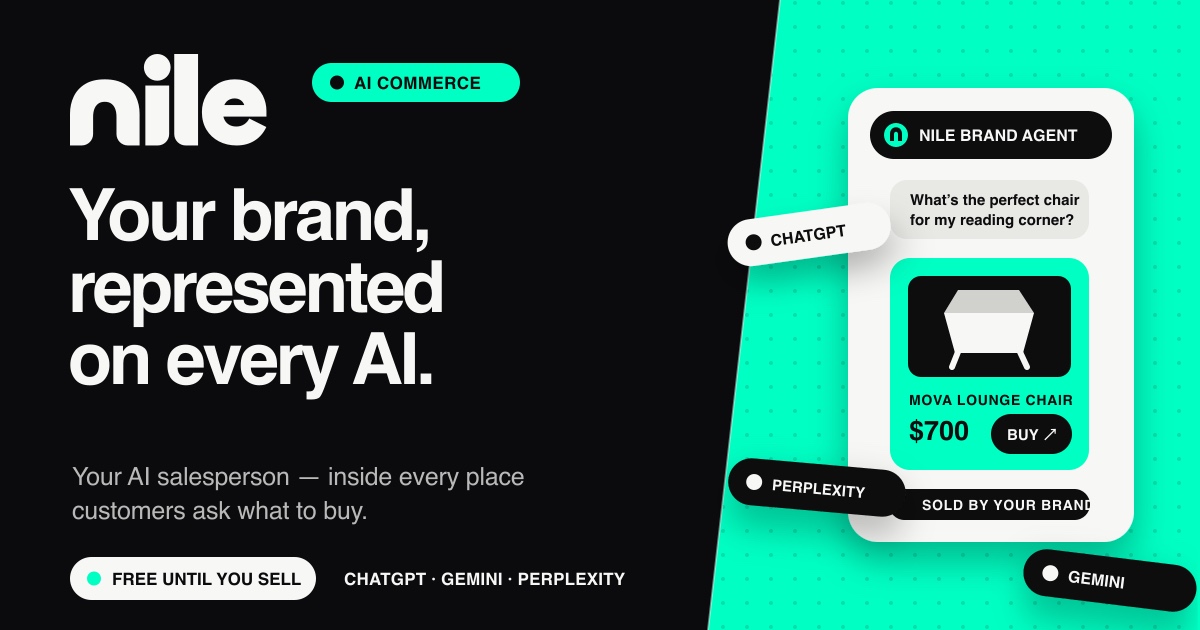
Nile targets merchants, ecommerce brands, marketplaces, retailers, and enterprise brand portfolios, and positions itself as “the unified agentic backend for brands”. It emphasizes being 100% agent-first from Day One, natively adapted to the A2A protocol rather than an add-on to traditional ecommerce; the official site also states “Your brand, represented on every AI” and “Live in 10 minutes · Your store, your checkout, your customer”.
Its premise is that traffic entry points are moving from search pages and ad slots to AI agents, while the cost of traditional acquisition paths keeps worsening. The fact sheet cites Adobe measuring AI-referred retail traffic up 693% year over year, converting 42% better than non-AI traffic; the English material on the site also calls out the pressure on traditional channels — “CAC keeps rising. Affiliates take 20%. Ads convert less every quarter.” — meaning affiliates take 20% and ad conversion declines every quarter. Tool fragmentation is another pain point: “ACP, UCP, a new AI channel every month. You shouldn't need 30 tools to keep up.” — a brand should not need 30 tools just to keep pace with new AI channels arriving monthly; Nile's answer is “Seller central for AI distribution. Plug and play.”
On results, Nile states that 95% of customers see click conversion at 150–300% of their on-site baseline, while the Chinese-language facts say agentic channel conversion reaches 150%–700% of site levels, with some brands up 1800% year over year. These figures should be read as official or case-study statements and rechecked before launch.
Core features
AI catalog restructuring
Automatically converts the existing product catalog into structured data adapted to agent understanding, adding deep metadata and semantic information. The English copy on the site also notes that product pages written for Google do not necessarily make an AI's shortlist, because agents build shortlists from structured context.
Intent matching engine
Matches products in real time against user query intent, so products appear in the AI interactions that actually drive purchase decisions. Coverage includes ChatGPT, Gemini and Google AI Mode, Perplexity, Meta and TikTok's shopping surfaces, and private or in-house agents that speak MCP. The fact sheet says that when rails such as Amazon's Buy for Me and Apple's agentic Siri open to brands, they should become new compile targets rather than new projects.
Continuous automatic optimization
Automatically tracks AI model changes and channel rule updates, continuously adjusting product positioning and visibility without manual intervention; merchants can control claims, voice, and guardrails in natural language.
Demand-side traffic and order return
Actively builds trusted shopping sources inside AI apps such as ChatGPT and Perplexity; orders flow directly back to the original store backend, and merchants fulfill through their existing process. The English material stresses “Your checkout, your customer, your data. A channel, not a middleman.” and notes that platform checkouts tend to take the data and the repeat buyer, while Nile keeps both with the merchant.
How to use
- Create an account: visit the Nile official website https://nile.shop/ and create a merchant account.
- Connect your store: authorize via Shopify or another platform connector; the system automatically syncs catalog, price, inventory, and fulfillment rules.
- Let AI take over operations: Nile automatically restructures the catalog, matches intent, and optimizes display; the merchant does not need daily management or technical maintenance. Official materials say it takes about 10 minutes to connect and publish.
- Receive and fulfill orders: orders flow back to the original store backend, and you check out and fulfill as before; in one case-study figure, a brand recorded its first agent-sourced sale in under 24 hours.
Use cases
- DTC brands expanding channels: DTC brands with annual GMV from tens of millions to several hundred million dollars gain high-intent traffic entry points in AI apps such as ChatGPT and Perplexity without adding a dedicated team.
- Cross-border merchants going global: Chinese merchants going overseas can close the information gap, plug directly into the North American agentic commerce ecosystem, and match products precisely to agent users' purchase intent.
- Category leaders staking a claim: top brands in categories such as electric scooters, digital pens, and mattresses are securing agent search and recommendation placements, building first-mover brand mindshare for the agent era.
- Independent-site merchants filling a gap: merchants with standalone stores outside Shopify get the same agent distribution, intent matching, and AI catalog restructuring as platform merchants.
- Agencies serving at scale: marketing agencies onboard clients to agentic commerce channels in batches, replacing traditional ad buying and influencer distribution with predictable CPC costs.
Strengths
- Non-invasive integration: the existing site is unchanged, no tools are rebuilt, and prices are not adjusted; the agent-facing shelf is set up independently.
- Zero day-to-day management: AI automatically adapts to model changes and channel rules; no dedicated staff or engineering team is needed.
- Protocol-native: 100% agent-first from Day One, natively adapted to A2A; the materials also mention ACP, UCP, MCP, and the Nile Agentic Protocol, with the goal of keeping brands from maintaining a separate tool for each new channel.
- The cost model is framed as transparent: Chinese-language facts describe transparent CPC pay-per-click with no installation fee, no monthly fee, and no hidden costs; English-language facts say “No setup fee. No retainer. No contract. Commission-only pricing.”
- Growth cases are specific: the fact sheet keeps “$44,574 in organic AI sales in 45 days — 2× conversion on their highest-ticket recovery devices”, “First sale in under 24 hours of connecting”, and “AI-sourced orders became a real channel within a month — with zero ad spend on their end.”
Limitations
The fact sheet does not provide verifiable pricing tiers, fee rates, free trial terms, contract lengths, service levels, supported regions, compliance certifications, data residency, cancellation terms, or third-party reviews; it also does not state the support boundary for complex custom fulfillment, multi-currency tax, B2B negotiation, offline store inventory, or highly regulated categories. Conversion rates, the 10-minute launch, time-to-first-order, and GMV cases all come from the provided materials and should be treated as official or case-study figures rather than universal guarantees. If a brand requires a fully self-built protocol stack, fully private deployment, or no reliance on an external agent backend, control, data ownership, and exit mechanisms should be added to the evaluation checklist before onboarding.
Pricing verification note
The public materials contain two pricing statements: one says “transparent CPC billing — pay per actual referral click, with no hidden fees, no prepayment, and no monthly subscription”; the other says “Commission pricing” / “commission-only” / “No setup fee. No retainer. No contract.” These may correspond to different plans, stages, or page updates; do not merge them into a definitive price on your own. For volatile information such as pricing, available channels, fee rates, billing cycles, and whether setup or monthly fees apply, defer to https://nile.shop/ and the latest official statements, and ask for a written quote before signing.
FAQ
Will Nile replace my standalone store?
No. The materials stress “Your store, your checkout, your customer”: orders flow back to the original store backend, and merchants fulfill through their existing process. Nile is closer to a new AI distribution layer than a middleman.
Can I use it without Shopify?
Per the materials, yes — you can connect via feed, CSV, or API; the Chinese-language facts also explicitly state that merchants with non-Shopify standalone stores get the same agent distribution, intent matching, and AI catalog restructuring capabilities.
How long does it take to go live?
The official figure is “Live in 10 minutes”: after you connect Shopify, a feed, CSV, or API, the catalog is compiled and published. In the case studies, one brand recorded its first agent-sourced sale in under 24 hours, but actual speed depends on catalog quality, authorization, and channel review.
Does it support entry points beyond ChatGPT and Perplexity?
The materials list ChatGPT, Gemini and Google AI Mode, Perplexity, Meta and TikTok's shopping surfaces, and private or in-house agents that speak MCP; rails that open to brands later should become new compile targets.
Why is it said you don't need 30 tools?
The English material on the site points out that protocols such as ACP and UCP and new AI channels appear almost every month, so a brand should not have to maintain 30 tools to keep up; Nile's approach is to compile the brand once and distribute it across every surface through a unified agentic backend.
Alternatives
The fact sheet does not list any verifiable comparable tools; it only offers two descriptive clues: “Tencent Cloud's Skill quick-install tool for Chinese users” and “an AI Agent-native workspace built for one-person companies”. So no competitor list is fabricated here. When comparing candidates, use the same coordinates: do they support entry points such as ChatGPT, Perplexity, and Gemini; can they sync quickly via Shopify, feed, CSV, or API; are they non-invasive and do they preserve checkout and customer data; do they offer AI catalog restructuring, intent matching, and continuous optimization; is pricing CPC, commission-only, or monthly; and do they provide verifiable cases and written pricing?
Official website and primary sources
- Official website: https://nile.shop/
- Continue verification on the official site: Nile Agentic Protocol, agentic commerce glossary, agentic commerce for merchants, case studies, and pricing/how it works pages.
Frequently asked questions
What is Nile?
Nile is an agentic commerce backend purpose-built for the Agent era. It helps brands convert products into AI-native listings and connect to agent channels such as ChatGPT and Perplexity without changing their existing site or hiring developers.
How does Nile charge?
The public fact sheet keeps both statements: “transparent CPC — paid per actual referral click, with no installation fee or monthly fee” and “No setup fee. No retainer. No contract. Commission-only pricing”. Volatile pricing information should be confirmed against the latest pages at https://nile.shop/ and a written quote.
What connection methods does Nile support?
The fact sheet lists Shopify, feed, CSV, or API; after connecting, the system automatically syncs catalog, price, inventory, and fulfillment rules, and the official figure is about 10 minutes to go live.
Who owns the orders and data?
The materials stress “Your checkout, your customer, your data. A channel, not a middleman.” Orders flow directly back to the original store backend, and merchants fulfill through their existing process.
How should Nile's conversion results be understood?
The fact sheet includes several official or case-study figures: 500+ customers served; agentic channel conversion at 150%–700% of site levels, with some brands up 1800% year over year; English materials say 95% of Nile customers see click conversion at 150–300% of their on-site baseline. These are not universal promises and should be rechecked before launch.
What do the 20% and the 30 tools on the official site mean?
English facts say “CAC keeps rising. Affiliates take 20%. Ads convert less every quarter.” — affiliates take 20% and ad conversion declines each quarter; meanwhile protocols such as ACP and UCP and new AI channels appear almost every month, and brands “shouldn't need 30 tools to keep up”. Nile replaces that tool fragmentation with a unified agentic backend.