
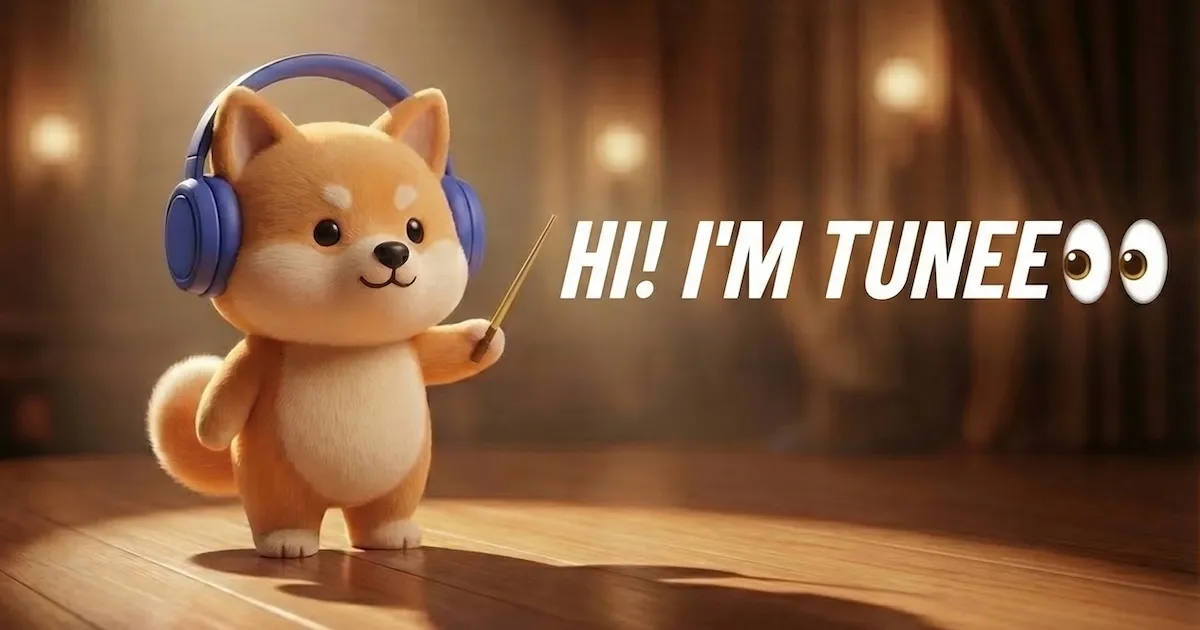
Tunee is a conversational music creation agent released by the Tianpuyue team. Built around natural-language interaction, it interprets vague style and mood descriptions and generates complete songs with verse and chorus structure and sung vocals, then keeps adjusting style, tempo and lyrics through dialogue. Beyond creation it offers music video generation, intelligent mastering, stem separation and a royalty-free commercial licence, aimed at music lovers, content creators and teaching.
Tunee: a conversational music agent that writes, arranges and sings
Most music generators ask you to specify everything up front: genre, tempo, instrumentation, mood, one field at a time. Tunee takes a different route. Built by the Tianpuyue team, it is a conversational music creation agent: you describe the feeling you want, it asks follow-up questions like a producer would, and then hands back a finished song with verses, choruses and vocals.
It works from vague requests. Descriptions such as sad but hopeful or as energetic as a workout track are turned into an executable direction, and the output is a complete piece including lyrics, composition, arrangement and vocals across styles from pop to rock to Chinese traditional.
Beyond text, it reads images, video and audio. Upload a clip or a still and it picks up the emotional shifts to score against; upload a melody and it can serve as the starting point.
The more important part is that the song stays editable. A generated track is not a one-off: you keep asking in the conversation, changing style, tempo or lyrics, until it lands close to what you had in mind.

Main features
Three generation modes
Fast mode submits your instruction and lyrics and returns a track quickly. Web search mode retrieves current information before analysing the request. The combined mode searches first, then quickly drafts prompt and lyrics. Which one to pick depends on whether you weight speed or precision.
Multimodal input
Melodies, video clips and mood descriptions can all be uploaded, and it picks up emotional movement from video and images so the music fits the picture.
Iterative collaboration
Results improve through conversation. You give notes the way you would to a human producer instead of rewriting the prompt from scratch each time.
Music video generation
After a track exists, a matching MV can be generated with image and video techniques, and you can adjust aspect ratio, time range and visual style.
Intelligent mastering
Mastering aims to keep the sound consistent across playback devices and platforms, using either a reference track supplied by the platform or one you upload.
Stem separation
Tracks can be split into vocals, drums, bass and other parts for later editing or remixing.
Royalty-free BGM and commercial licensing
Generated music comes with a commercial licence document, so it can be used in short videos, ads and podcasts with less infringement risk. The exact scope still follows the terms the platform states at the time.
How to use it
- Sign up. Visit the Tunee website and register with an email address.
- Describe the idea. Use plain language, for example an atmospheric track for a short video; it asks follow-ups to confirm direction.
- Pick a mode. Choose fast, web search or the combined mode depending on the task.
- Use prompt bubbles. Preset suggestion bubbles speed up a first draft, or write your own.
- Ask for several options. One request can produce multiple directions, two songs each. Say you want them all to explore in parallel, or request two more within the same direction.
- Make an MV. Ask for a music video in the conversation or press the button, then refine effect and parameters by chatting.
- Download a lyric video. A full lyric video can be exported with a static template using the cover art or a dynamic ripple template, in landscape or portrait.
- Re-edit and remix. Change lyrics or prompt, keep the original melody or re-arrange, set a custom title and cover, and remix in one click from the library.
- Master and export stems. For release or delivery, run mastering and export separated tracks.
Who it suits
- Musicians and creators: produce melody, lyric and arrangement drafts fast and spend the time on polishing.
- Short-video and social creators: get background music that matches the mood while avoiding rights problems.
- Podcasts and audio shows: intros and beds for episodes, audiobooks and radio drama.
- Game and film post-production: atmospheric cues and sound material for scenes.
- Teaching: let students hear abstract form and arrangement ideas as finished pieces.
Points to keep in mind
- Output quality varies. The same description can produce noticeably different results across runs, so expect to generate several versions and choose.
- Commercial terms need reading. The exact scope, limits and permitted platforms of the royalty-free licence follow the official terms, and important projects should keep the licence record.
- Lyrics and vocals still need review. AI lyrics can read vague or rhyme awkwardly, so human editing before release is sensible.
- Mastering and stems depend on the source. Source quality and mix density affect the result, and complex material may not land in one pass.
- Features and quotas may change. Generation counts, available modes and export options usually depend on the account plan, so confirm the current rules first.
FAQ
What is Tunee?
A conversational music creation agent from the Tianpuyue team. Describe what you want in natural language and it produces a complete song with lyrics, composition, arrangement and vocals, plus music videos, mastering and stem separation.
Do I need music theory?
No. It accepts vague mood and scenario descriptions and asks follow-up questions, so you do not need a professional prompt up front.
Can the music be used commercially?
The platform provides a commercial licence document for generated music, usable in short videos, ads and podcasts. Check the official terms for the exact scope and limits.
Can I change a song after generating it?
Yes. Lyrics and prompt can be edited, the original melody kept or the track re-arranged, title and cover customised, and a remix created in one click from the library.
What inputs are supported?
Text descriptions, images, video clips, audio and melodies can all guide style and mood.
Can I get several options at once?
Yes. One request can return multiple directions with two songs each, and you can keep adding versions within the same direction.
Frequently asked questions
What is Tunee?
A conversational music creation agent from the Tianpuyue team. Describe what you want in natural language and it produces a complete song with lyrics, composition, arrangement and vocals, plus music videos, mastering and stem separation.
Do I need music theory?
No. It accepts vague mood and scenario descriptions and asks follow-up questions, so you do not need a professional prompt up front.
Can the music be used commercially?
The platform provides a commercial licence document for generated music, usable in short videos, ads and podcasts. Check the official terms for the exact scope and limits.
Can I change a song after generating it?
Yes. Lyrics and prompt can be edited, the original melody kept or the track re-arranged, title and cover customised, and a remix created in one click from the library.